Friday, February 12, 2016

Correcting Drainage Problems with Beautiful Landscapes

Last year, I received a call from a potential client looking to correct some major drainage problems in their yard.  When I investigated the property, I found the walkout sitting in a bowl with dense clay subsurface soil, four down spouts draining water from the roof into the lower backyard and only one small drainage pit leading to nowhere. 


The homeowners hoped to finish their walkout basement, but had delayed for years because the basement flooded during heavy rain event.  The water would sit, several inches deep, on the surface for days.  Previous attempts to mitigate storm event flooding by contouring and use of swales beyond the "bowl" had failed.  More extensive steps were needed. 


After meeting with the homeowners and identifying their goals, I developed a plan to both eliminate the flooding and maximize use of the awkward space.  The area includes a large paver patio, segmental retaining and sitting walls (Wellington Wall by Belgard), and boulder retaining walls, Chilton outcropping steps, a rain garden in the lower area and extensive mixed gardens above.  We also added drip irrigation for area that receive minimal water, and a narrow sod path between the gardens and the patio.

The excavation crew removed approximately two feet of heavy clay soil over a three thousand square foot area within the bowl, sloped the grade away from the home and toward a large stone filled pit which, ultimately, included a sump pump that can pump the water out of the bowl and into a swale above the bowl.  The swale, which this year will be turned into a naturalistic dry stream bed, carries the water off into an open field away from the house. 


To Learn More About How I Can Help You Solve Your Challenging Landscape Problems, Call or Text Brent Now:
(616) 328-3258

Sunday, November 2, 2014

Sketchup For Landscape Design

This year, I started designing with Pro Landscape design software and Sketchup . Pro Landscape is an excellent program for creating 2d and photo-realistic designs. While Pro Landscape can be used for creating 3d designs, it requires significant re-working of the Planner design to achieve a viable design. The transfer from 2d to 3d is not seamless.  The amount of work required to reach an acceptable 3d design does not seem worth it at this point.

Though it is possible to create photo-realistic designs from digital photographs. It is not possible to create these designs starting with previously created 2d or 3d design.  I believe Landscape Pro needs to add to its training videos.  At this point they provide only remedial training via videos.

The following is a sampling of my Pro Landscape designs in the program's Planner and Image Editor modes:
Landscape Design in Grand Rapids, MI
Landscape Pro Planner

Landscape Design - Grand Rapids, MI - Landscape Pro Planner

Landscape Design Alt. - Grand Rapids, MI
Pro Landscape Planner enables user to choose among several design styles rapidly by selecting an button on the screen.
Driveway Island Landscape Design - Richland, MI -
Pro Landscape Design - Photo Realistic Image Editor

Asian Inspired Relaxation Garden - Holland, MI
Pro Landscape Design - Photo Realistic Image Editor

Sketchup, on the other hand, is intuitive and highly useful for creating 2d, 3d designs and walk-throughs and photo-realistic pictures. There is no need to switch between 2d and 3d modes. 2d designs can be transformed into 3d designs using simple actions. Really getting to realistic looking designs takes a lot of practice and time, but it's worth it. Photo-realistic pictures can be shot from within the design by adjusting the view of the built-in camera. This program is made easier because it is an open source program used by thousands of professional architects, landscape and interior designers, engineers, artists, etc. constantly tweaking and adding to available models.  These models can be submitted to Sketchup and integrated into the designs of other users.  Check out some of my new Sketchup landscape designs:

Outdoor Kitchen and Living Space in Dowagiac, MI

Outdoor Kitchen Side View - Sketchup
For professional landscape design services, 
call Brent Langley at (616) 328-3258.
Outdoor Kitchen - Sketchup
Landscape Design - Holland, MI
Sketchup Camera Top View 

Monday, March 24, 2014

How To Build Dry Stacked Natural Stone Retaining Walls


Dry Stacked Natural Stone Retaining Walls

Purchasing Your Boulders/Wall Stone: 

When looking for natural stone for your future retaining wall, first search for “gravel pits” in your area. Because they are in the excavation business, they have access to the many boulders buried in their pits, often setting them aside for sale to landscapers (or other consumers in the know). Keep in mind, however, the machines they use are extremely large and therefore unfit for loading boulders into your truck or trailer. Because of this, you will find it necessary to either load them by hand (which can be very difficult because of their shear weight and awkwardness) or you will need to rent a small loader.  If you rent a loader to load the boulders, you will have to unload them by hand at the jobsite. This too can be difficult if you do not have a dump truck or trailer. However, with patience and the proper tools, you can do it this way and save yourself a lot of money. 

Stone Yards are another option. These are very popular for several reasons: First, they can save you a lot of time and labor. Stone yards can load the boulders for you if you have an open-bed vehicle. Also, stone yards generally offer delivery. Second, stone yards have access to a wide selection of stone from all over the country. The best yards can obtain stone from all over the world. However, with selection comes increased price. Stone yards sell stone significantly higher than gravel pits. They probably purchase their boulders from gravel pits and must recover the cost of shipping the stone from the pit to their own site. Not a cheap thing to do.

Depending on your location, you may be able to save even more money by scamming fieldstone from fields in the area. Especially keep in mind any farms or ranches you may have seen while driving around lately. Farmers often have large piles of boulders moved aside while preparing their fields for planting. Before you make off with any boulders, make sure you get permission from the owner of the property from which you intend to "pilfer".


Choosing the Right Stone For Your Dry Stacked Stone Wall Project:
Types of Natural Stone Available for Retaining Walls
Weight and Dimension:

It is essential, when choosing your rocks, to keep a few things in mind. You may think my first recommendation is obvious, but it must be said. It is easy to find boulders you love at the stone yard only to discover when you get them to your site you can’t budge them. So, plan ahead. Know how you intend to manipulate your boulders once they’re home. Don’t choose boulders that you cannot move. That does not mean you must be able to pick them up. However, you must determine your ability to access and use the tools necessary for the project. (I will take you through some of the many options available, and how to utilize those later).
Because stone density varies due to composition, it is impossible to give you precise weights per boulder or square face foot. Nevertheless, I have taken the time to give you some estimates based on my experience and those of other professionals. Below are estimates of weight based on dimension for various regions and rock type:
*Face feet assumes average thickness of the wall is 18".  Actual thickness will affect Face Feet.
*The List Below is stone readily available in Michigan:
Region                          Rock Type                    Estimated Weight                       Pounds/Face Foot
Pennsylvania/NY         Bluestone                      162.5 pounds/cubic foot             243.75 lb/face foot
Wisconson                   Chilton                          168 pounds/cubic foot                252.00 lb/face foot
Wisconson                   Fon Du Loc                   162 pounds/cubic foot                243.00 lb/face foot
Mid West                     Granite                          160 pounds/ cubic foot               240.00 lb/face foot
Michigan                     Michigan Fieldstone     170 pounds/per cubic foot          255.00 lb/ face foot
Michigan                     Michigan Limestone     155 pounds per cubic foot          132.50 lb/ face foot
Canada                        Canadian Limestone      165 pounds per cubic foot          247.50 lb/face foot
Michigan                     Grindstone                     136 pounds per cubic foot          204.00 lb/face foot

The Right-Size Wall Stone for Your Project

Building Stone: Different natural stone wall projects call for different size stone. For the sake of stability, use the largest boulders you can handle.  Retaining walls under two feet tall can be built using 10-18” boulders. Vary the sizes and shapes in order to give it a more natural look. Larger walls should be built using 18”-36” boulders. Boulders over 24” will probably require a machine to install.

Small Boulder Retaining Walls and  Rosetta Dimensional Steps
Shims: Whatever the size of the boulders you intend to use always keep some smaller angular stones handy for use as shims. Shims are used to increase contact between rock surfaces and thus improve stability. They can also help stablize rocks that rock.  Use a sledge hammer to set any shims that will be filling spaces between boulders.

If the soil at your sight is rich in either clay or humus, you will need crushed stone and rubble for backfill. Proper backfill improves drainage and keeps frost heave (a problem in cold northern parts of the county) from shoving boulders out of your wall. 

Building Your Retaining Wall

Before you do anything else, locate any underground utilities. Most municipalities have programs set up to provide free or inexpensive utility location. Give them a call. In Michigan you need to call MISS DIG. Next, mark out the base of your retaining wall using spray paint. Make sure you keep in mind the set back. Allow for a minimum of 1 inch set back per 12 inches of height. For walls over five feet, set back should be 1.5” per ten inches of height.  Once you have marked out the front of your wall, begin digging a trench approximately 1 ½ times the depth and 2x the thickness of your average wall stone.  Dig 6-12” in front of face of the wall.  Boulder Walls can be built by simply digging individual stones into the soil so they sit about 1/3 of the total height into the ground.

Chilton Dry-Stacked Retaining Wall
If you are using stacked  stone such as Chilton or Bluestone, it will be necessary to dig at least six inches deeper than the average thickness of your stones.  This will allow for a compacted "chips n dust" or crushed concrete base.  You will need to dig your trench  wide enough to allow for a minimum of 6 inches in front, and 6 inches behind the wall's base layer.   Thus, if your average wall stones are one (1) foot wide, front to back, you will dig your trench 2' wide.  Doing this will ensure a stable base and keep your stones from sinking or tipping forward or backward.  

To learn more about my services and begin planning your professionally designed and installed retaining wall project,
Call or Text Brent NOW
(616) 328-3258.

Brent Langley in East Grand Rapids, MI on Houzz

Friday, March 21, 2014

Creating Harmony in the Landscape: Color Schemes

In the landscape, harmony refers to the way in which various elements in the landscape are organized to create a sense of unity or continuity within an individual garden area as well as between distinct areas within the overall landscape. Various elemental types can be used to create harmony within a landscape. Each element adds a new dimension of unity within the garden and landscape. Among these various elements, I would like to emphasis the following: Color Schemes, Hardscape elements, Repeated Forms, and Green Spaces.
Let’s first consider color schemes.  Color Schemes are probably the most easily identified element in a landscape, and therefore the most habitually emphasized. Color schemes rely on specific color combinations that can make or break a garden. They can create harmony or consonance within the landscape.  Therefore, color schemes must be chosen with care to ensure you accomplish your express purpose. 
The most exciting combinations are not always planned.  As you create your gardens, you will unexpectedly come across combinations that excite your senses.  Feel free to experiment with new partnerships. Choose an individual color, several analogous or complimentary colors to be used throughout the landscape. 
Color partnerships can be separated into two categories: contrasting/complimentary colors and analogous/harmonizing colors. When contrasting colors are combined, they tend to draw attention to themselves through explosive relationship. Tension is created, heightening our senses and drawing our eyes to them. By standing out, these vibrant color combinations further emphasis the more harmonic color combinations. Seizing our attention, these contrasting color combinations can highlight transition between two areas in the landscape. Beware: too many dissonant color combinations can destroy a garden. Our goal should then be to limit these contrasting color combinations in order to emphasis the overall unity of the garden or landscape. I often combine purples with complementary yellows in smaller numbers or greens with bright reds as seen in the Poppy or carnation.
Complimentary colors, on the other hand, are soothing.  They create a sense of serenity. Try using blues and purples or reds and orange.  When transitioning between color combinations, use neutral colors such as whites, silvers, greys and blacks. (Check out this free online interactive color wheel to learn about color wheel theory http://thevirtualinstructor.com/interactivecolorwheel.html).
It is easy to focus exclusively on flower color. However, flowers come and go. They blossom and fade with the seasons’ change. Foliage, however, is longer lasting and often “evergreen” and thus the more significant color producer in the landscape. I would, therefore, encourage you to try basing your color scheme on the foliage of one or more specimen plants. Consider basing your color scheme on the hues of elements such as tree and shrub bark, boulders, garden sculptures and brick or natural stone pavers.
Hardscape elements repeated in the landscape can also draw together a disparate landscape. Thus, when you are dealing with various themes such as formal and informal areas, perennial, annual or mixed, sun and shade gardens, consider using common hardscape elements such as stone or brick. Both of these can be used in a number of applications. For instance, granite can be used to create a very appealing patio or walkway as well as retaining walls, stream beds, accent rocks or sculptures. Perhaps you could use granite to create a unique water feature such as a fountain surrounded by granite pebbles. Then, use the same granite pebbles or a crushed form of granite to create a meandering path through a woodland garden with granite outcroppings.

Repeating a particular plant such as a Rhododendron or weeping Japanese Maple could also add another unifying element.  Often you will find such plants can be grown in both sun and shade with adjustments to irrigation scheduling. 

Try using Redwood or Cedar in both your fencing as well as your decking application.  Match the brick in your front walkway to the brick on your house. It may be difficult to match the house and walkway precisely, especially if your home is more than a couple of years old. However, there is almost always another brick that will coordinate with the existing house brick.

Thursday, March 20, 2014

Carefree Delight Roses: Pruning Rose Bushes in Spring

I have three large shrub roses in my front yard - Carefree Delight Rose.  I have done relatively minor pruning for the last five years to keep the shrubs around six feet high during the summer and five during the winter.  They have made a wonderful hedge along the front ramp and brought many compliments because they bloom almost continuously from mid Spring through late fall.  Extra pruning a couple times a year increases the number of blooms, but is not strictly necessary.


Now, the maples in my front yard are maturing and casting shadows.  In addition, the Carefree Delight Rose grows approximately six feet tall and five feet wide.  The growth of both the trees and rose bushes has led to thinning foliage and branches along the base of the shrubs. 

So, this Spring I cut them back hard to encourage new growth, especially in  each base and interior.


Most rose bushes benefit from hard pruning either in the Fall or in the Spring. I generally prune shrubs for my clients in Fall. This keeps the canes from cutting each other during the storms of winter.  Wind and snow push the canes together so the thorns tend to slice as they move along other stems. 

Here you can see the winter damage to a large section of this rose bush. 
The branches are dull grey and tan and lack any new leaf buds seen on the healthy branches.  The damage that caused this die back is located further down on a larger branch but is most visible all of the branches seen here.

This damage increases dead branches making it more difficult to prune in Spring.  On the other hand, leaving the pruning until Spring, allows you to enjoy the bright orange rose hips throughout winter.  This picture exemplifies the extreme damage that can occur as a result of thorns from one branch cutting through the bark of another.  This branch as become twisted and weak and could, eventually lead to significant damage to the rest of the shrub if not pruned.


You can make use of the time between now and when the snow finishes melting by trimming your roses.  First, you will cut back the complete rose bush by two thirds.  Here I have trimmed back three Rose bushes to the main canes in order to restore structure to shrubs that have become unruly.


These buds are located where a leaf joins the stem. Since most rose bushes (in cold climates) lose all of their leaves during winter you can identify the lateral buds by locating the nubs along the cane where the branch seems to bend or angle in another direction.  

Lateral bud on a young cane.
Lateral bud on an older cane.


Cut the branches at a 45 degree angle approximately 1/4" above and away from the lateral bud.
Next, remove all dead and crossing branches. This will reduce future damage. All together, you will want to thin the shrubs by a third to half.    So, once you have removed all the dead branches, you may still need to remove some healthy growth.  This will enable air, light and water to penetrate the interior and lead to a healthier plant. Try to remove branches evenly.
Some branches will have winter kill on their tips. Simply cut these back to a healthy lateral bud.
Crossing branches, such as those seen in this picture, can damage each other and create openings for disease and insect invasion.


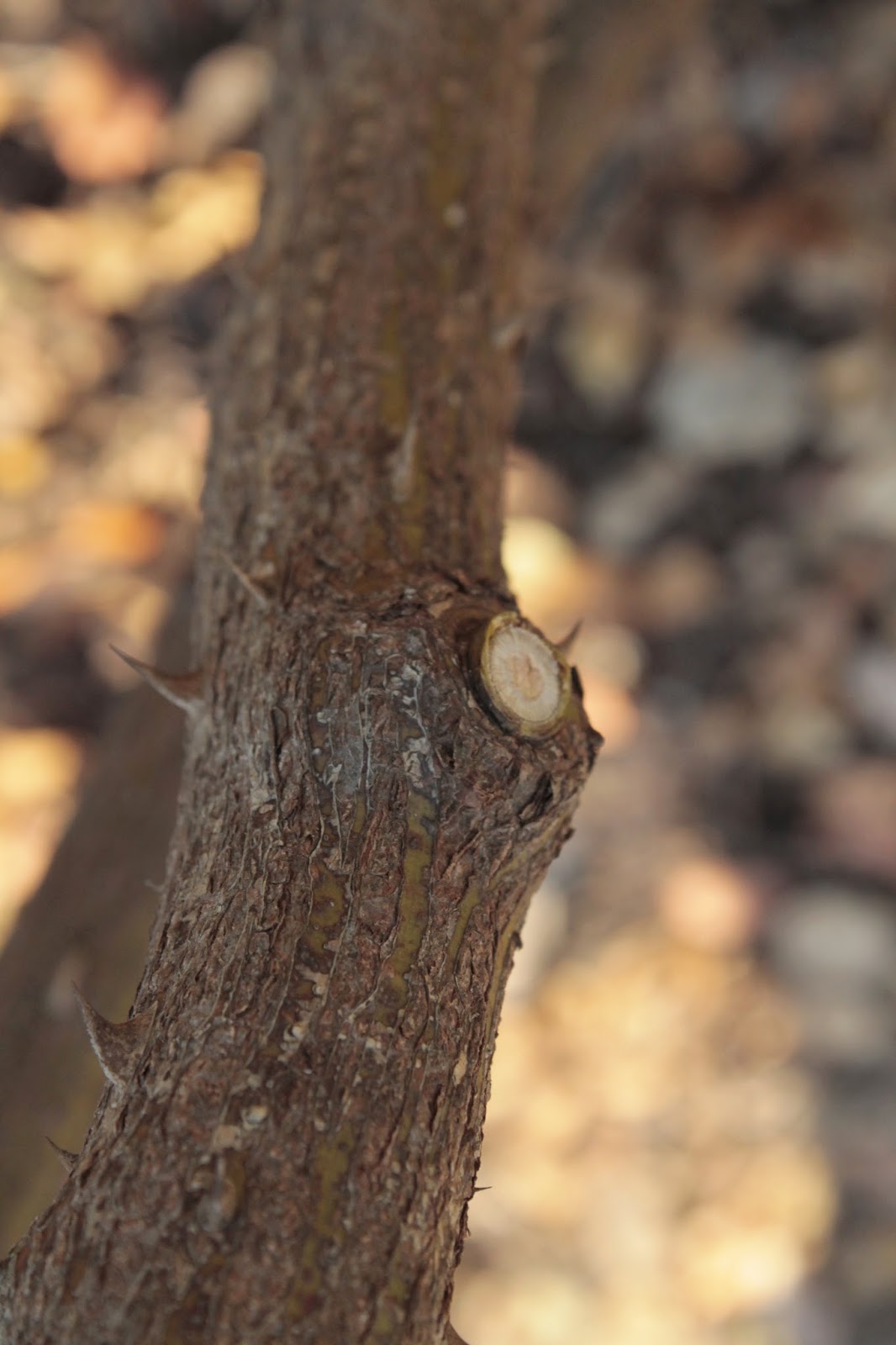
Cut branches that are completely dead all the way back to a living cane as seen here.  Avoid cutting into the collar which surrounds the base of the branch.  Damage to the collar can keep the wound from healing properly and lead to further damage.


Notice the hole that was caused by the thorns of another rose cane.  This hole is creates access to insects that can damage the cane, as well as interfering with flow of nutrients to the Rose bush.


Now that the rose bushes are pruned back to a simple framework, you can reach the base where old canes have not been cut back all the way to the base.  Some of these old canes, such as those seen here, may be dead and need to be removed to a living branch.

Tuesday, March 18, 2014

Late Winter Early Spring Landscape Maintenance Projects

Snow Snow Snow.  Almost gone right?  Not quite.  I still have several inches of snow in my front yard and mounds along the street and driveway.  But it soon will be gone.  For those of you just itching to get outside and start working on your yards, there are things that you can do now to prepare your gardens for Spring.

Pruning Trees and Shrubs:

Today, I pruned a severely over-grown Crab apple tree for a client.  Dead branches, from previous hard pruning, had fallen in among the living branches.  The previous pruning had focused exclusively on the outer portions of the tree, leaving many dead branches still clinging to live ones.  The majority of dead branches were the result of years of insufficient light, water, and air reaching the leaves.  I pruned out and removed all the dead branches, along with excessively dense live branches, to allow air, rain, and sunlight to penetrate deep into the tree. 

Most likely, you can handle pruning small trees.  When you prune your trees, remove all dead branches along with any crossing or touching branches.  Branches growing vertically without secondary branching should also be removed.  These are suckers if they emerge from the roots or base of the tree trunk, or water sprouts if they grow from the trunk or branches.  Water sprouts are usually caused by previous pruned or broken branches.  Both suckers and water sprouts suck energy from the tree and cause it to grow weakly and irregularly.  Suckers can grow from any point along roots near the soil surface.  Crabapple, Aspen, Beech, Birch and Dogwood are particularly susceptible to suckering.

Now that the harsh winter weather is almost behind us, it is possible to start pruning the shrubs too.  One of the first chores in my own yard this year, will be inspecting the shrubs close to my house.  Usually, I get small amounts of snow falling from the roof over the full length of the winter. Not this year.  The constant extreme cold allowed snow and ice to build precipitously on my roof.  Guess what.  When we had a few warm days, all that ice and snow slid from my roof and landed on my shrubs.  I have never had this problem before.  I had one chunk of ice crash down on top of half a dozen Burning Bushes.  Crushed most of them in one foul swoop. 

So, I will be headed out once that snow and ice has melted, to cut most of those to the ground or close to it.  If you have the same issue, don't worry, most shrubs actually benefit from a hard pruning.  If you are in doubt, feel free to message me or send me a text with a picture of your plants.  I will be glad to advise you on an individual basis and help you identify the shrub and the best solution to your unique situation.

Cleaning Up Debris:

I don't know if you are seeing the same thing, but I have noticed an unusual amount of debris in my yard and on the streets this year.  Now that the snow is melting, all the garbage that blew out of the garbage trucks over this long harsh winter, all the leaves that waited to fall from the trees until the snow started falling, all those branches broken by ice storms and heavy snow falls and fierce winds, all the dog leavings abandoned by people too cold to stop to pick up the mess (mostly me and my kids), is being exposed by the slow melt.

Well, it's not too cold to do the clean up now.  If you do, as I am doing, a little at a time as it is exposed, this unpleasant chore won't feel so overwhelming.  And when the enjoyable part of Spring garden chores is possible, you will be ready.  The leaves may have to wait a bit. 

Live in the West Michigan Area and have some Spring Landscape Maintenance that needs doing but don't have the time, energy or inclination to do it, give Brent a call at (616) 328-3258.  I'll be happy to give you a quote on getting your landscape in shape for the season.

Wednesday, March 12, 2014

Severe Winter Hits Honey Bee Population Hard: Plants to Help Honey Bees

Last month a guest on NPR discussed the severe drop in the Honey Bee population over this winter due to the severe weather.  Record low temperatures and high snowfall in the midwest along with reduced food sources resulted in bees starving and freezing. 

This year's decline, combined with a yearly decrease in the honey bee population of approximately 30%  for the past decade could have a devastating economic affect on the Midwest.  There are multiple contributers to the bee problems Michigan is facing, among which are: seasonal food shortages, Colony Collapse Disorder, changes in weather patterns, and improper use of insecticides.

Because Michigan is among the top five states for commercial beekeeping operations and the state relies on bees to pollinate 50% of its crops, this should concern everyone.  Bee pollinated crops account for over over $1 billion in sales in Michigan alone, in addition to the $7.4 million in honey production in 2009 (http://msue.anr.msu.edu/news/using_honey_bees_for_fruit_pollination).  This issue is of both financial and ecological concern to everyone living in Michigan, the Midwest, and anyone relying on crops produced here.

Among the crops pollinated by honey bees in the Grand Rapids, MI area are blueberries, cherries, raspberries, strawberries, pumpkin, asparagus, alfalfa, apples, onions.... MSU publication Using honey bees for fruit pollination identifies seventeen crops pollinated by these insects.

In order to bolster the honey bee population, landscape designs should include plants that help tide bees over during the crop "off season".  The following is a list of trees, shrubs, and perennials that can be purchased in Grand Rapids, MI, and grown in your home landscape to encourage establishment and survival of honey bee colonies in your area.  Included are approximate dates during which honey bees forage these plants (information derived from numerous sources including: http://www.ginlc.org/education/bee_friendly_plants.htm and http://www.countryfarm-lifestyles.com/honey-plants.html and http://saginawbees.org/honeyplants.html and http://www.missouribotanicalgarden.org/PlantFinder).
 
Trees Attractive to Honey Bees
Acer rubrum 'Autumn Blaze' (Red Maple): March-April
Salix melanostachys (Pussywillow): March - April
Cercis canadensis 'Forest Pansy' (Redbud): April
Prunus 'Snofozam' (Snow Fountain Cherry): April
Rhus aromatica 'Gro-Low' (Sumac): April-May
Malus 'Prairifire' (Apple): Late April - Late May
Liriodendron tulipifera (Tulip Tree): May-June
Tilia americana (Linden/Basswood): June

Garden Perennials Attractive to Honey Bees
Crocus: March-April


Phlox subulata (Creeping Phlox): April-May
Alyssum saxatile ‘Compactum’ (Perennial Alyssum): April-May
Aubrieta x cultorum ‘White Wall Gem’(Rock Cress): Late April-May
Ligularia stenocephala 'Little Rocket': late April to Late May
Nepta x faassenii ‘Walker's Low’ (Cat Mint): April-September


Leucanthemum x superbum 'Snowcap' (Shasta Daisy):
Allium 'Globemaster': May through June
Lychnis viscaria ‘Firebird’ (Catchfly): May-June
Melissa officinalis (Lemon balm): May-June
Trifolium (Clover): Late May-Late June
Thymus serpyllum ‘Magic Carpet’ (Mother of Thyme): May-August


Salvia nemerosa ‘May Night’ (Sage): May-August


Lavandula angustifolia (Lavander): June-August
Lupinus 'Gallery' (Dwarf Lupine): June-August
Malva sylvestris ‘Zebrina’ (Malva): June-August


Gaillardia aristata ‘Burgundy’ (Gaillardia): June-September
Echinacea 'Pixie Meadowbrite' (Purple Coneflower): June-October
Monarda 'Cambridge Scarlet' (Bee Balm): July-August
Allium senexcens subsp montanum Mountain Garlic: July-August


Achillea millefolium 'Moonshine' (Yarrow): July-September
Agastache foeniculum (Anise – Hyssop): Early July-Mid September
Eupatorium pupureum ‘Joe Pye Weed’: July-September


Rudbeckia hirta ‘Goldsturm’ (Black Eye Susan): July-October
Pervoskia atriplicifolia 'Little Spire' (Russian Sage): August-September


Echinops ritro (Blue Globe Thistle): July-August

Sedum 'Autumn Joy' (Stone Crop): August-October
Anemone tomentosa 'Robustissima' (Robust Windflower): Sept-Oct
Aster oblongifolius 'October Skies' (Aromatic Aster): Early September-October
 
 
Annuals Attractive to Honey Bees
Snap Dragon
Nasturtium

 
Natives Attractive to Honey Bees


Zizia aurea (Golden Alexanders): April-July
Physocarpus opulifolius (Common Ninebark): May-July


Veronicastrum virginicum (Culver's Root): May-August
Monarda punctata (Horsemint/Spotted Beebalm): June-July
Ratibida pinnata (Yellow Coneflower): June-August
Allium cernuum (Nodding Wild Onion): June-August
Spiraea alba (Meadowsweet): June-August
Vernonia missurica (Missouri ironweed): July-August
Asclepias incarnata (Swamp Milkweed): July-August

Scrophularia marilandica (Late Figwort): July-September

Cacalia atriplicifolia (Pale Indian plantain): July-August
Silphium perfoliatum (Cup Plant): July-September
Agastache nepetoides (Yellow Giant Hyssop): July-September
Eupatorium perfoliatum (Boneset): July-September
Lobelia siphilitica (Blue Lobelia): July-September
Helianthus strumosus (Pale-leaved Sunflower): July-September
Aster novae-angliae (New England aster): August-September
Solidago riddellii (Riddell's goldenrod): September-October
Aster laevis (Smooth Aster): September-October
Sambucus canadensis (American elder): June-July
Prunus spp. (Wild Cherry): March
Aronia melanocarpa (Black Chokecherry): May
Cornus amomum (Silky Dogwood): May-June


Pictures of these plants will be added as they are taken. All pictures are originals by Brent Langley.

If you are interested in adding some of these plants to your landscape or garden, and would like some help with design and/or procurement,  feel free to call Brent Langley at (616) 328-3258.